What are NFTs, these virtual tokens that are snapped up at a high price?
Thanks to the blockchain, even works of art can now be authenticated and secured like a Bitcoin.
After money, it is therefore the turn of the art to digitize itself… and this is based on NFTs, non-fungible cryptographic tokens. But what is it exactly?

Last Sunday, Canadian singer Grimes put up for sale a digital art collection, dubbed “WarNymph,” and won no less than $ 5.8 million from the sale.
One of the works in the collection, depicting a baby guarding Mars (below), hit an all-time high, trading for over $ 300,000 on its own. Said works of art are in fact certified by NFTs, for
Non-fungible tokens, or, in French, non-fungible tokens. For weeks, sales of these NFTs have exploded and reached records. But, what exactly is an NFT?
Interesting read: Run your ads on a platform that cares about your business and only pay when you get clicks.
NFT is to art what Bitcoin is to money
The NFTs are currently on the rise. In February, the creator of Nyan Cat was selling a copy of his work for $ 580,000, while crypto-artist Beeple traded his latest work - depicting
Donald Trump lying naked in the grass - for nearly $ 6.6 million. , a record. These NFTs have today become essential on the art market. But how do these digital items, like Bitcoin , work on the Blockchain ?
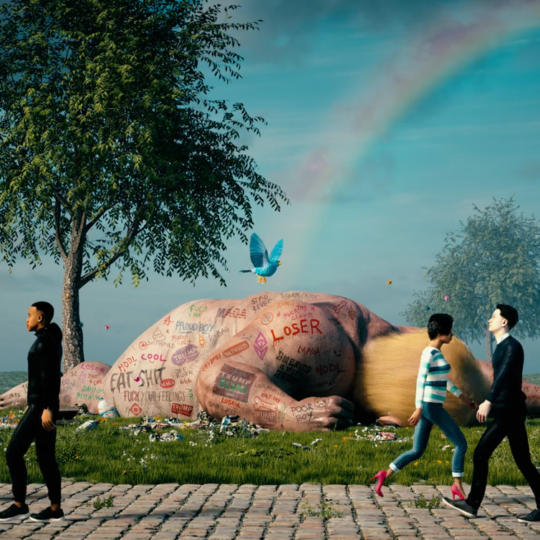
To popularize as much as possible, we can put this in parallel with video games, where we can generally buy virtual objects, such as a weapon or even an armor.
In a game where the developer would infinitely multiply the same item, and where each player could buy it, we would be in the situation of classic crypto-currencies.
Interesting read: Put NFTs aside. With birdchain, Play fantastic games and get rewarded crypto. Install the app now
Except, if the developer of this hypothetical title decided to include only one of these items for all players,
it would be unique and, inevitably, its value would soar due to demand.
It is more or less the same principle with these NFTs, the main feature of which is that they are not fungible.
Where an entire Bitcoin can be exchanged with another whole Bitcoin, and will retain the same value, such as when exchanging a 10 euro note for another 10 euro note, NFTs have a unique identifier that differentiates them from from each other.
This is the case for example on Sorare, a platform that we had the opportunity to test . We then say that they are non-fungible since they have their own identity, like a work of art, and these virtual tokens are exchanged according to supply and demand.
The fact that NFTs are not fungible is also the reason why they are not particularly suitable for the art market.
The blockchain gives value to the digital item, a tamper-proof digital certificate of authenticity, at a time when the question of certifying the authenticity of works of art is under debate.
The digital object can then be exchanged on platforms like Nifty Gateway, where most of these new crypto-artists offer their works for sale.
This success remains in any case proof that blockchain can affect many other sectors, starting with art. In any case, this would clearly cast doubt on the thought of Walter Benjamin, famous author of
“The Work of Art in the Age of its Technical Reproducibility” , who already anticipated the infinite reproduction of digital objects, but did not anticipate the infinite reproduction of digital objects. had not foreseen the emergence of this future technology.
other articles
Best trading pairs on the market

Comments
Post a Comment